Wednesday, April 2, 2014

Growth in the global economy. Why does the industrialzied world continue to stagnate?

In a recent working paper "Sluggish Postcrisis Growth: Policies, Secular Stagnation, and Outlook"  Canuto, Nallari, and  Griffith investigate why  advanced economies continue to have low growth. Is this slow postcrisis growth the result of a policy response that was overly reliant on monetary policy, which ran into the zero interest rate lower bound before growth was restored? Looking deeper, is secular stagnation, which is related to the zero lower bound and was recently brought to the fore by Larry Summers, another potential cause for advanced economies’ failure to return to pre-crisis growth levels? This note seeks to answer these questions as well as identify what alternative policies might be pursued by advanced economies to escape secular stagnation, should stagnation proponents be proven correct. After a brief review of secular stagnation, Summers’ hypothesis is tested through a review of academic literature and opinion pieces. However, the secular stagnation theory is not without its critics; moreover, there is a debate between “Keynesian versus Schumpeterian” economists, which could help to shed light on the medium-term postcrisis outlook.

Book: 
Liquidity trap pp. 104-106.
Saving glut (Paradox of Thrift) p. 46.
Secular slowdown (Long Wave), pp. 140-144.

Sunday, February 9, 2014

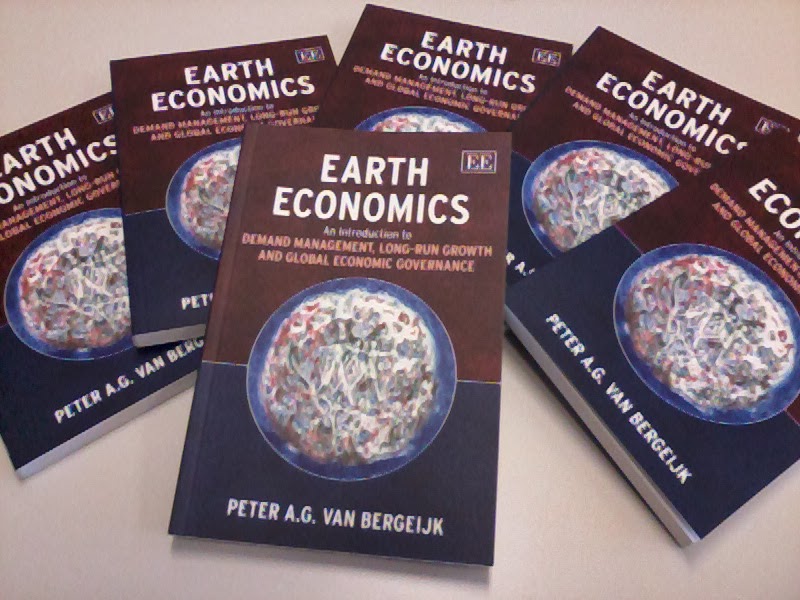
Paperback Earth Economics

Just released and note that Edward Elgar gives an additional 20% rebate when you order direct through www.e-elgar.com

Monday, January 13, 2014

Global liquidity as an early warning indicator of asset price booms

377 - DNB Working PaDate 22 May 2013 pers We test the performance of various measures of global liquidity as early warning indicators of booms in house and equity prices in 20 OECD countries between 1970 and 2010. We use a panel probit approach to test the relative performance of global liquidity measures based on two aggregation schemes: the traditional measures, based on G5 data, and broader measures, based on data for up to 26 countries/currency areas. Our results show that, in the last decade, global liquidity measures outperformed domestic measures as early warning indicators. Between the two global liquidity measures, G5 aggregates often outperformed broader global liquidity measures. The search for the best early warning indicator showed that the G5 real narrow money gap performed best for booms in house prices, while the global real private credit growth gap performed best for booms in equity prices, either when aggregated over G5 or over a broader sample of countries. Nevertheless, given the rising importance of the emerging market economies and a declining share of G5 in global liquidity, the current superior performance of G5 measures may not warrant their superior performance in the future. Therefore, given the importance of global liquidity measures in warning about asset price booms, the need for constructing broader global liquidity measures is warranted. Keywords: Early Warning Indicators, Asset Price Booms, Global Liquidity. JEL Classification: E44, E51, F65, C53. DNB working paper 377- Global liquidity as an early warning indicator of asset price booms ww.dnb.nl
Wednesday, January 1, 2014

Secret message?

IMF watchers all around the world are puzzled. Why a desert? What does the Fund know what we do not know?

Thursday, September 12, 2013

Growth update

 
The growth-slowdown is visible in the update statistics (using latest IMF WEO data). Makes the case that full recovery (i.e. a return to trend) is not in the books yet even stronger.

Book: p. 26.

Saturday, July 6, 2013

Update on the global fiscal stance


Fight the middle income trap


How to Avoid Middle-Income Traps? Evidence from Malaysia

Authors: Aaron Flaaen, Ejaz Ghani, and Saurabh Mishra

 Malaysia’s structural transformation from low to middle income has made it one of the most prominent manufacturing exporters in the world. However, in the competitive global economy, like many other middle-income economies, it is sandwiched between low-wage economies on one side and more innovative advanced economies on the other. What can Malaysia do? Does Malaysia need a new growth strategy


To read more: http://siteresources.worldbank.org/EXTPREMNET/Resources/EP120.pdf


Book: p. 135.